Monday, May 18, 2015

Event 2: Hammer Museum

From the 2010 EXPO Shanghai and the 2012 London Olympics I heard about the great English designer, Thomas Heatherwick, who is gifted in generating innovative ideas, but I know little about his real talent and how his designs improve things around us until I recently visited his exhibition “Provocations: The Architecture and Design of Heatherwick Studio” in Hammer Museum. I not only harvested times of delight from figuring out how his designs delicately resolve the question but also was mesmerized by his designs filled with both novel and aesthetic feeling.

The first thing directly attracting every tourist of the exhibition is the “spuns” at the entrance. “The Spun Chair has the appearance of a sculptural vessel. But when leaned on its side, it becomes a fun and functional chair that lets you rock side to side or spin around.”(hermanmiller.com) As the explanation shows, the chair really gives my girlfriend and me a lot of fun when we spinning with the chair. People are worried about falling from the chair when they first cautiously spin it, especially when they lean backward. However, as the introduction shows, the special design of spun chair just provides people with both comfort and pleasant. As a chair, the spun chair really does not possess the ordinary appearance of a chair for people’s daily usage and the look of it gives it much artistic specialty.
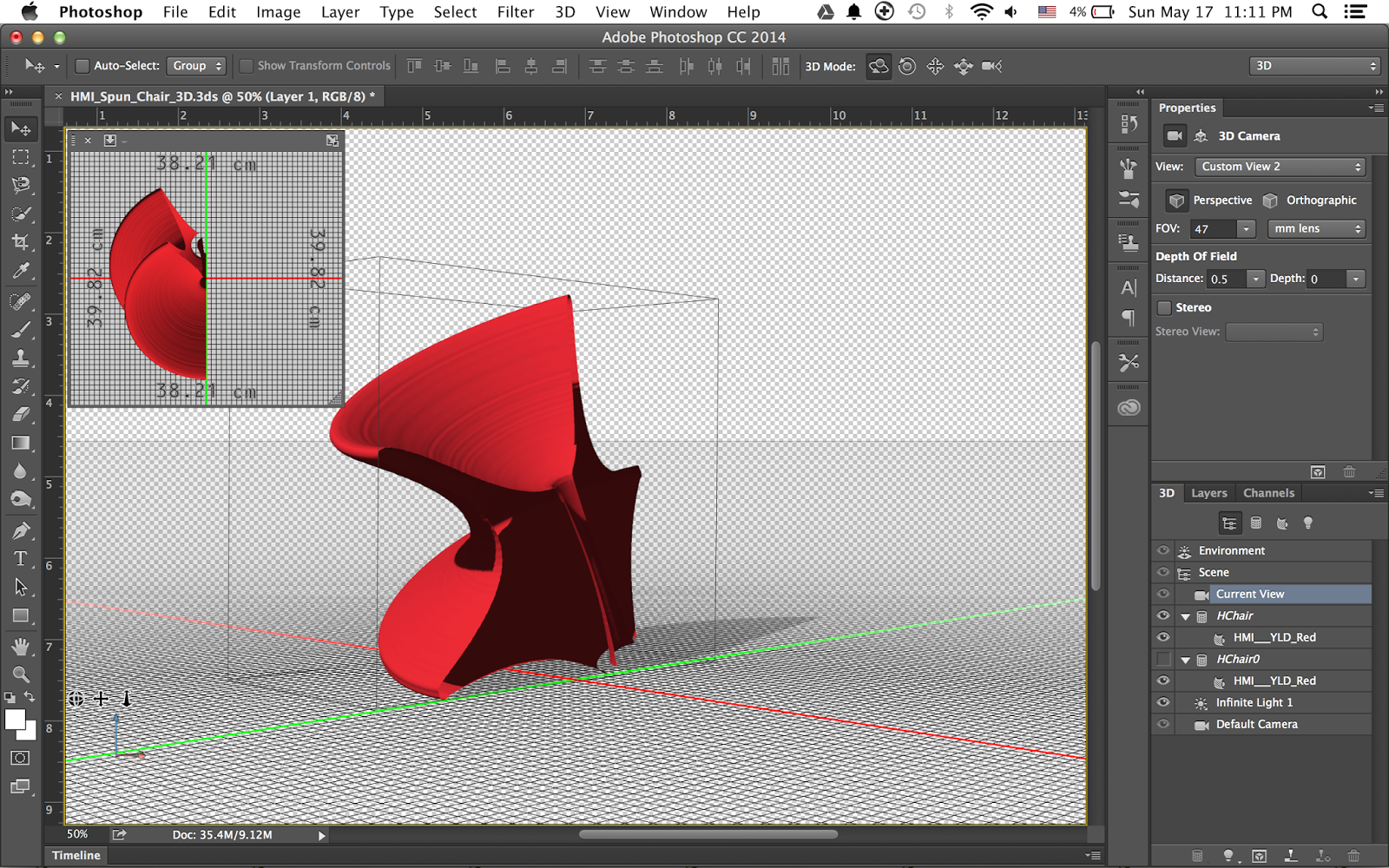
Because of my great interest of the design, I used the Photoshop to further study the 3D models of the spun chair when I was back home. It is obvious that the artistic design also relates to some ergonomics and physics knowledge. From the 3ds model, we can see that the upper disk has little bit smaller diameter than the lower one, providing people with the largest sitting area while preventing the chair from falling down and insuring the stability. If we look inside of the chair, there is a thin pillar at the center, which supports all the weight put on the chair so that it cannot be squished. Also, from the Internet research I know that “the designer created the Spun Chair using a rotational molding technique to shape plastic.”(upinteriors.com) It is also a field of engineering. Therefore, it can be concluded that the design of a simple chair combines art with other science and technology as we learned from the course.

Entering into the main exhibition, I felt a strong sense of creativity, novelty and science and technology. Although not technically an architect, Thomas Heatherwick is a designer with a lot of architectural experience. “He has a studio in London which produces many architectural designs, but that is not all. He is a designer who tried to revolutionize the ways that objects are approached and used. He has been called "the new Leonardo of design.”(The-Archi-Blog.com) Designs like the stairs of Longchamp flagship store and the garden bridge all reflects the combination of both art and other scientific field like psychology, neurology, ecology and so on. “The magnetic properties of the landscape stair enable movable lights and display stands to be attached with high-strength magnets. The transparent balustrades are fabricated using aerospace windscreen technology to create a series of individually formed panels that drape with the fluidity of fabric.”(heatherwick.com) The stair successfully making the delicate psychological effect and driving people tend to move upwards by the fluid wave-shape. The design of the garden bridge, as large construction, further relates to a city’s overall figure and its people. As the application shows, “the environmental impact assessment has been undertaken in part to avoid or reduce negative environmental effects and to also identify and promote positive effects.” The assessment has considered the following aspects of the environment: Air quality, Noise and vibration, Transport, Ecology (land and river), Water (scour, flooding and drainage), Archaeology, Built heritage, Landscape, Visual effects, Socio-economics and so on. Reading the list, I cannot deny my great respect to Heatherwick as his design is not only a building or a functional construction, but also an artistic and a scientific blended works.


The visit of the Hammer Museum deeply made me feel what I learnt in the course and I would like to explore more for such inspiring creations in my daily life.

Reference:

"Spun Chair." Hermanmiller.com. Web.
<http://www.hermanmiller.com/products/seating/lounge-seating/spun-chair.html>.

"Spun." Upinteriors.com. Web.
<http://www.upinteriors.com/design/spun-by-thomas-heatherwick/>.

"thomas heatherwick on scale and critical thinking." The Archi-Blog. 26 Oct. 2013. Web. <http://archi-blog.weebly.com/context--history1/category/task 3 project 2 ergonomics64fcdbe9c4>.

"La Maison Unique." Heatherwick.com. Web.
<http://www.heatherwick.com/la-maison-unique/>.

Garden Bridge Planning Application - Environmental Statement: Non-Technical Summary. 2014. Page 8. Print.

Friday, May 15, 2015

Week 7: Neuroscience + Art

As we learned from the reading talking about neuroculture, “neuroaesthetics” exists nowadays as a new field of research, which considers subjective aspect of aesthetic experiences in the creation and appreciation of art works to be superimposed upon common and universal neural circuits. (Giovanni Frazzetto) The study of relation between neuroscience and art seems to offer me some scientific explanation of art’s attractiveness, and my research focuses on the significant neural functions on visualizing art works.

Like Picasso said, “Art is not truth. Art is a lie that makes us realize truth, at least the truth that is given us to understand.” If we do not believe in the lie, what is the meaning of art or things in the medium of art? I really agree “if we didn't buy in to the "lie" of art, there would obviously be no galleries or exhibitions, no art history textbooks or curators; there would not have been cave paintings or Egyptian statues or Picasso himself.” (Elizabeth) the article, what the brain draws from: Art and neuroscience, starting from art, discusses the fantasy effect of the integration of it with neuroscience. I begin to reflect what I noticed when I enjoyed some artistic works such as a painting. Actually, my brain can understand lines, colors, shapes or even some artificial visual illusion. Human nerves can explain all of these basic elements of art works.

In different cultures, even infant and monkeys can recognize the meaning of lines. People of Anthropolithic age started drawing in lines. Ancient Egyptian also used lines to outlines objects. The neural “edge detection” works for the recognizing of these lines. The cells reacting on bound of light and shadow in human’s visual system can also reacts to lines.

Much research indicates human’s preference to recognizing face. Mark H. Johnson’s meaningful question in his famous paper, Functional brain development in humans, “how does the physical growth of the brain relate to the emergence of new behavioral abilities during infancy and childhood,”(Mark) drives the discussion into a evolutionary level. From the theory of evolution, the origin of human beings is from what we now call animals. Obviously, the better an individual can find out the hidden predators or the potential dangers, differentiating enemy from themselves, more easier they can survive in the nature and inherit their genes. The different tissue structures in our brain can help us recognize different “faces” such as paintings of fine quality and rough quality. The conclusion is if we analyze details less, then we put more emotional feelings on the works.

Leonardo Da Vinci took advantage of the differences in the human central and
peripheral visual system to create a dynamic smile in the "Mona Lisa"  
Color and luminance are certainly playful in artists’ hands. The mechanism of colorful visual effect is mainly illustrated by GGB color model and opponent process. The RGB color model is an additive color model in which red, green, and blue lights are added together in various ways to reproduce a broad array of colors. The choice of primary colors is related to the physiology of the human eye; good primaries are stimuli that maximize the difference between the responses of the cone cells of the human retina to light of different wavelengths, and that thereby make a large color triangle. (Hunt) The color opponent process is a color theory that states that the human visual system interprets information about color by processing signals from cones and rods in an antagonistic manner. (Wikipedia.com) With these neural science, people can better understand that artist works such as Impression, Sun Rise by Monet will deceive people with a lighter orange sun of same luminance as background color actually.
In "Impression Sunrise" by Claude Monet, circa 1873, the artist makes the sun look
unusually bright by choosing an orange with the same luminance as the background
Reference:

Frazzetto, G., & Anker, S. “Neuroculture.” Perspective. November 2009. Print.

Landau, Elizabeth. "What the Brain Draws From: Art and Neuroscience." CNN. 15 Sept. 2012. Web. <http://www.cnn.com/2012/09/15/health/art-brain-mind/>.

Johnson, Mark H. "Functional Brain Development In Humans." July 2011. Print.

R. W. G. Hunt. The Reproduction of Colour (6th ed.). Chichester UK: Wiley–IS&T Series in Imaging Science and Technology. Print.

"Opponent Process." Wikipedia.com. Web.
<http://en.wikipedia.org/wiki/Opponent_process>.

Monday, May 11, 2015

Event 1: Fowler Museum

I had never been to either fowler museum or hammer museum before even though I already studied here for four years and they are just around me, but thanks to our class, which requires us to visit them so that I would not regret for missing such wonderful places. After surviving all my midterms last week, finally, I took my adventure to fowler museum.


The museum is really bigger inside than what I thought before, especially when I found out such a large amount of exhibits there. “Making Strange: Gagawaka + Postmortem” is the exhibition most attractive to me. It consists of two parts and both of them not only have strong visual impact from aesthetic effect but also involve the expansions of their meaning. The Gagawaka consists of various wearable, sculptural garments made from recycled materials and medical supplies. The idea of combining daily materials and fashion art just corresponds to the theme of our class, the study and analysis of relationship and connection of different subjects with art. The garments are made of materials such as sanitary napkins, respirators, rubber, plastic pipes or even bras.
The immediate inspiration for me from these garments origins from the most basic aspect: the recycling usage of daily materials reminds me of its advantage of “turning waste to wealth” and its realistic meaning in today’s environmental friendly trend. As Vivan Sundaram speaks, “Fashion is a commodity, but these are sculptural garments, so they cannot be commodified in the same way. They were produced to be looked at—and maybe to be worn once in a while. They maintain a tension between art and design, evoking multidisciplinary elements that are central to my practice.”(Zehra) I think whatever if the artist himself has the aspiration or not, his sculptural garments can exhibit as a conceptual lead to people’s notion of environmental recycling. I remembered in last several world cups, sports equipment companies like Nike had already developed and manufactured jersey or even footwear for athletes made from plastic bottles. First, those collected “plastic bottles are cleaned and shredded into pieces.” Then, these “bits are melted to become strands of polyester.” After that, “the polyester thread is woven into premium fabric for high performance apparel.”(Nike.com) The jerseys made up from plastic bottles are not only a great save of resources but also cheap, beautiful, light and comfortable. This is one of the realistic examples of combination of art and recycling technology.

More deeply, “while Gagawaka was seductive and quirky, Postmortem is decidedly macabre, but promises to be equally thought-provoking.”(Nidhi) The part postmortem comprises of mannequins tailors’ dummies, anatomical models, and wooden props used to present the human body on a more disquieting stage. This kind of artistic expression naturally leads me to our topic of medical science and art. The combination of it and the former part let the audience to think about how to draw line between real and artificial in a consumerist world. The mannequin is structurally available to being chopped up. One can play with hands and arms. As Sundaram says: “I explore themes of death and destruction, transforming these objects from inanimate to sculptural,” In this process of "opening up the body", he also humanizes the mannequins — seeing them re-configured in this manner invites, even compels, one to relate to them. (Nidhi) All of these deep and inspiring ideas through the expression of art combining with medical anatomy make me fascinated.


Reference:

Jumabhoy, Zehra. "Artforum." Vivan Sundaram. 20 Dec. 2011. Web. <http://artforum.com/words/id=29889>.

"FROM PLASTIC TO PERFORMANCE." Nike Better World. Web.
<http://www.nike.com/us/en_us/c/better-world/recycled/innovation>.

Gupta, Nidhi. "Split Wide Open: Vivan Sundaram Takes Back the Body." The Sunday Guardian. 2 Nov. 2013. Web.
<http://www.sunday-guardian.com/artbeat/split-wide-open-vivan-sundaram-takes-back-the-body>.


Friday, May 8, 2015

Week 6: BioTech + Art

My understanding of biotech starts from the art works like books and movies. I remembered the talk with friends about series of biotech companies, such as Umbrella Corporation of Resident Evil after watching the movie series when I was young. Interestingly, the biotech companies all act as villains and particularly exert themselves in research and development of biotech productions such as biology welfares or some genetic transformation injectant that they use to threat the world.
Like Umbrella Corp. of Resident Evil, fictional biotech companies
created and developed bio-weapons like virus to threaten the world.
Although I thought those crazy biotechnologists characters in artistic works were created for artistic and dramatic purpose, after learning today’s class, I recognized that, in reality, biotech is still a shocking and amazing science, just like professor in the lecture video summarized, especially applied to art creation by artists’ hands. The most impressive artist for me from the lecture is Joe Davis. I am astonished by the continuous thrust of unconventional ideas of Joe Davis—“the unstable isotope that you can’t quite predict.”(Rebeca) In a sense, all of Davis’ scientific projects are driven by his desire to experience sensory oddities. His unique embrace of both art and science makes it hard to categorize what he’s doing, and wonder if it even if it can or should be categorized. (Rebecca) Joe Davis’ brainstorm and projects raises me to the thought of Ruth’s question of the definition and value of artistic media and technologies. I thought his research just explores the limits of what is possible in technologically sophisticated art and media, both from an artistic and a biotech viewpoint. One of the comments on Joe Davis’ scientific and artistic creation value that I agree is “It might not have advanced science in a conventional way, but it would have been striking to behold.”(Dailygalaxy.com) I think that effect fulfill the artistic media’s value.
An example of BioArt, made with bacteria expressing 8 different colors of fluorescent proteins
Another concern about “BioArt,” the art practice where humans work with live tissues, bacteria, living organisms, and life processes, is the large amount of debate over the related topics such as moral principals. (Wikipedia) Just as Eduardo Kac claimed in an interview that the announcement of Alba’s death by lab is “in order to put an end to a two-year, unwelcome barrage of media attention.”(Kristen) Since the birth of GFP bunny, criticize and debate over the usage of artistic creation by biotech never stops. It reminds me that when first cloned animal Dolly was given birth, the clone technology received great focus both positive and negative. Especially when the clone is connected with human beings, criticize and debate over moral principals and ethics clearly reject the possibility of it happening. According to US state legislation, “fifteen states have laws pertaining to human cloning. The issue was first addressed by California legislature, which banned reproductive cloning, or cloning to initiate a pregnancy, in 1997.”(NCSL)

However, in my opinion everything has its own boundary. The development of biotechnology indeed helps scientists advance in their research to improve people’s life. Starting from a materialism angle, matter is the fundamental substance in nature, and that all phenomena, including mental phenomena and consciousness, are the result of material interactions (Wikipedia). My answer to Ruth West’s first question might be yes. In my opinion, since artists usually want to use the most effective issues or forms as medium to create most expressive works, because of the complicated nature of life itself, it can certainly be an expressive medium of art, or even better in producing greater values.

Reference:

Sato, Rebecca. "The Brilliantly Weird World of MIT’s 'Mad' Scientist." Dailygalaxy.com. 10 Mar. 2008. Web.
<http://www.dailygalaxy.com/my_weblog/2008/03/the-brilliantly.html>.

"BioArt." Wikipedia. Web. <http://en.wikipedia.org/wiki/BioArt>.

Philipkoski, Kristen. "RIP: Alba, the Glowing Bunny." Wired. Web.
<http://archive.wired.com/medtech/health/news/2002/08/54399?currentPage=all>.

"Human Cloning Laws." NCSL. 2008. Web.
<http://www.ncsl.org/research/health/human-cloning-laws.aspx>.


"Materialism." Wikipedia. Web. <http://en.wikipedia.org/wiki/Materialism>.